



Volcanic Winter or “Little Ice Age” in 2027/8
February 5, 2025Content
Introduction to Preventive Astrology
Natural phenomena can be predicted, and therefore we can prepare for them.
This is my conclusion after applying the measurement units of axial precession—Aeons (the Platonic year) of 25,776 years, Eras of 2,148 years, suberas of 179 years, and half-suberas of 89.5 years—to natural phenomena such as volcanic eruptions, earthquakes, and solar flares. All of them respond positively when this technique is applied, completing their cycles or half-cycles on the expected dates, demonstrating that the predictive method of axial precession works.
Years ago, I applied this same predictive technique to organise the timeline of the Eras, using historical, social, and economic events from the past. These events also demonstrated, by naturally aligning above or below the wave frequencies of Aeons, Eras, and suberas, that there is a natural order in the events that affect us. There exists a cyclical order in which events manifest—a pattern governed by axial precession and its subdivision into 12 fields of the ecliptic, further divided into 12 by the curves or waves generated, which I refer to as harmonic wave frequencies.
The branch of astrology known as world astrology or mundane astrology has always focused on this area of traditional astrology, specialising in forecasting global events. It does so by analysing planetary transits and the so-called small and large cycles of planetary transits that occurred in the past, extracting information about their effects on society at the time. This information is then extrapolated to the present or future, when the same cycle is expected to recur, thereby enabling predictions of its consequences.
It is important to recall in this section another predictive method, the oldest of them all, known as the **Yugas** or the **four Yuga periods**, in which the ancient sages of the Indus civilisation divided time. From that era, a vast body of written information has survived, including texts such as the *Mahabharata*, Krishna’s dialogues with the goddess Ganges, the *Vedas*, the *Upanishads*, and the *Bhagavad Gita*, all of which remain in common use in India today. From these texts emerges the concept of an eternal cycle of time—a wheel from which there is no escape—interpreted since antiquity as the circumference generated in the plane of the ecliptic by the planet’s axial movement and tilt, known as axial precession. I provide the complete information in The Organisation of Time in the Eras, so I will not elaborate further here, except to emphasise that the Yugas agree in stating that during Yuga transitions and their changes, natural phenomena such as critical global events take place.
Within astrology, there is another virtually unknown branch called precessional astrology or astrology of the Eras, which is the one I experiment with. This branch does not use planetary transit cycles but rather these measurement units in years of axial precession, applying them directly to the date when an event of any nature occurred in the past. By applying one of these measurement units to the event’s date, it is possible to calculate when its half-cycle or full-cycle will repeat, observing that when the resulting number is an exact unit or its half, recurrence occurs.
I will begin the analysis of natural phenomena from the most distant past, the Ice Ages, gradually moving forward in time to examine the phenomena that have occurred over the last four years. Finally, I will delve into the near future, up to 2049 AD, to emphasise the significance of the year 2025 AD, when the analysis concludes that the cycle of X-class solar flares will repeat.
Last Ice Age
The analysis I present below covers the period of the last 26,000 years, corresponding to the last Ice Age, known as the Würm glaciation, and its subsequent period called the Holocene. Since it is the most recent period, it is also the easiest for geologists to analyse, as more reliable and abundant information can be obtained the closer the period is to our present time.
In both periods, the natural phenomena of the Würm glaciation and the radical temperature changes of the Holocene align perfectly with the peaks and troughs of this 2,506-year pattern I have identified. This 2,506-year cyclical pattern is essentially a wave frequency or curve directly related to the 25,776-year axial precession, as it can be measured using one of its units, the subera of 179 years, which divides it exactly 14 times.
| Glaciation/Interglaciation | Start, in years |
|---|---|
| Holocene | 9,700 BC |
| Würm Glaciation | 110,000 |
| Riss-Würm Intergracial | 140,000 |
| Ross Glaciation | 200,000 |
| Mindel-Riss Intergracial | 390,000 |
| Mindel Glaciation | 580,000 |
| Günz-Mindel Intergracial | 600,000 |
| Günz Glaciation | 850,000 |
| Holocene Stages | Start, in years |
|---|---|
| Temperature increase | 10,000 BC |
| Holocene Maximum | 6,000 BC |
| Cooling | 2,500 BC |
| Medieval warm period | 900 AD |
| Little Ice Age | 1,300 AD |
| Global Warming | 1,850 AD |
COOPER AGE
From 5,000 BC to 1,800 BC
BRONZE AGE
From 1,800 BC to 800 BC
IRON AGE
From 800 BC to 1st Century BC
Holocene Temperature Variations
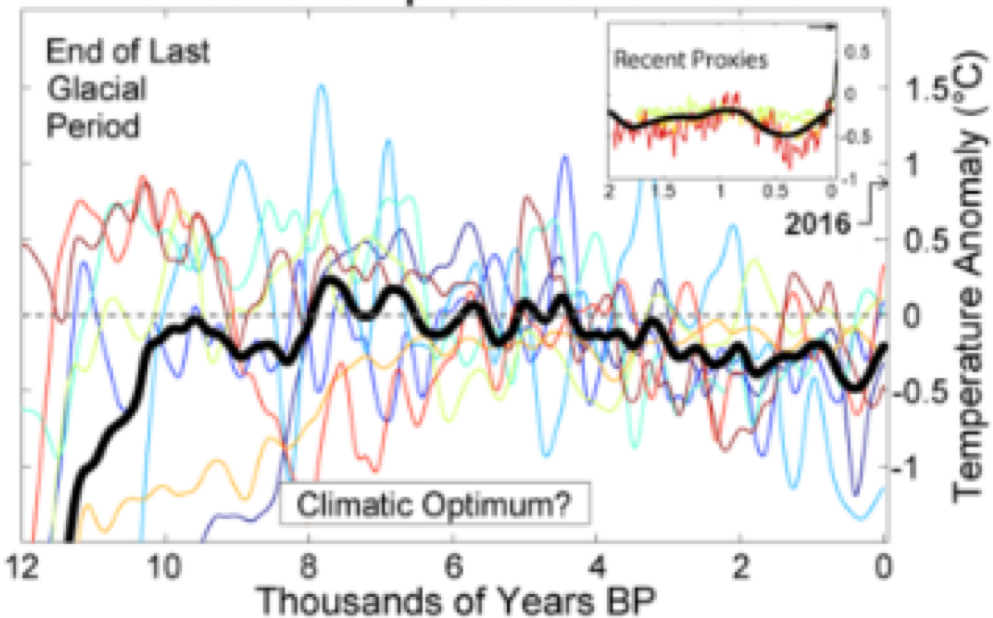
What is fascinating about this analysis is not only that all the periods of the Würm glaciation and the Holocene align with the peaks and troughs of these wave frequencies, but also that, when the predictive method of the Yugas is applied, these periods fit perfectly alongside them. This includes the two most powerful X-class solar flares ever recorded, the phases marking the development of our recent ages—known as the Ages of Metals—and the collapse of empires due to climatic events. All of these share a common link: they are the result of natural phenomena, whether on a large or small scale.
Similarly, the Würm Glaciation of 110,000 years is divisible by 2,148 years, or one Era, and once again results in either a whole number or 0.5.
I calculated when the Era of Cancer occurred within that period, and it was in 111,804 BC. Both represent the same moment; they are the consequences of a fluctuation, of a change, and, of course, as any astrologer knows, it had to occur under the sign of Cancer—the beginning of humanity. The other possibility would be Aries, but that sign signifies the beginning of everything, not specifically of humanity.
111,804 / 2,148 years = 52.0 Eras
It is well known that axial precession, along with its axial tilt, governs the Earth’s climate, always taking into account the apsidal precession cycle of 110,000 years, which completes one revolution around the Sun. No one questions the scientific rigour of the fields that study this subject or the quality of their work. On the contrary, astrologers also engage with this domain, as axial precession is, in fact, the origin of astrology. The debate lies in the fact that science does not, in any way, accept the division of axial precession into 12 parts—a division astrology employs in its understanding that the 25,776-year circumference, known as axial precession, has a cosmobiological relationship with the 12 signs representing the 12 constellations that surround us.
The predictive method of using the measurement units of axial precession by dividing it into 12, and then into another 12, as an invisible wave frequency—similar to the harmonic waves of music or sound—when applied to natural phenomena, and more specifically to organising the periods of the last Ice Age and the Holocene, yields indisputable evidence: these periods automatically align with the peaks and troughs of this wave frequency. This is further proof of the existence of an order, a hermetic relationship in the style of “As above, so below,” a deterministic cycle of repetition, an expression of the cosmos reflected in the events on Earth, and ultimately, a demonstration that everything has an order—the cosmobiological order.
- About the Dryas, more info.
- About the Ice Age, more info.
- About the Orbital Variations, more info.
Events from natural phenomena during the last Ice Age fit into a 2,506-year axial precession pattern
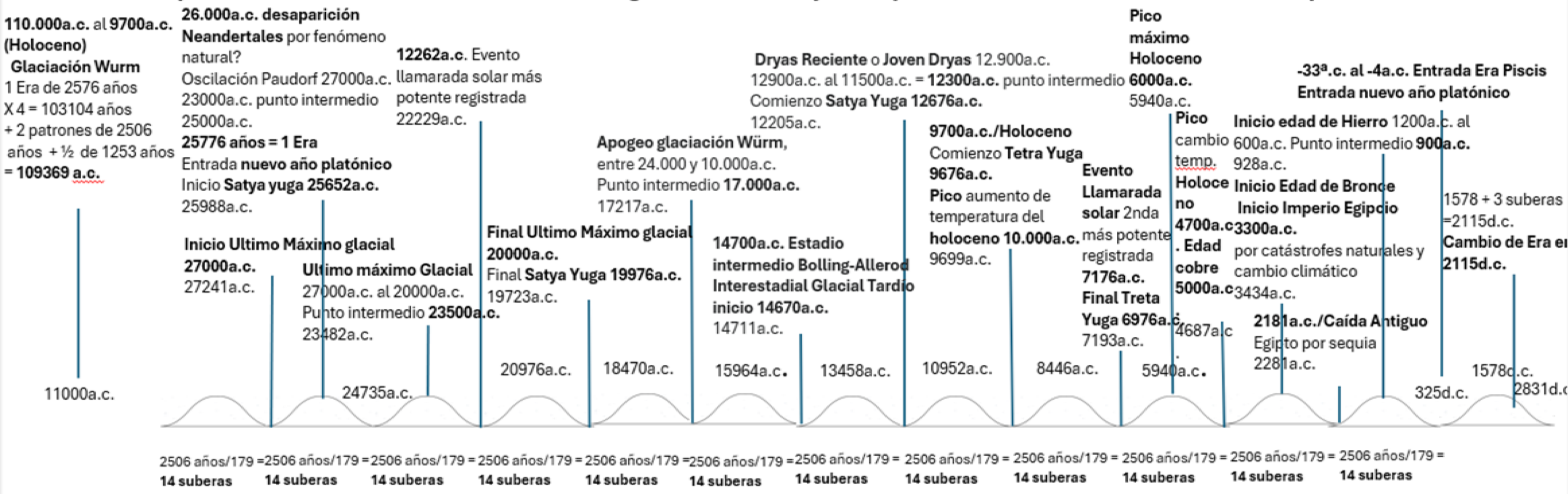
Repetition Pattern: 2,506 years
Axial Precession Repetition Pattern: 2,148 years.
2,506/pattern- 2.148/axial precession cycle= 358 years
358 years/179 = 2 suberas exactly. Axial precession governs this pattern in suberas and, therefore, the last Ice Age
Obliquity Cycle in Axial Precession Eras = 4,100 years/2,148 = 19 Eras
Axial Precession Cycle= 25,776 years/2,148 = 12 Eras
Apsidal Precession Cycle in Apsidal Precession Eras = 112,000 years/2,148 = 52 Eras
Yugas: Vedic Time Organisation in Four Time Periods.
At the beginning and end of each Yuga, natural catastrophes occur.
The analyses I present below are based on recent natural phenomena—events that have occurred over the past four years, during which I have been testing this predictive technique. There remains a vast number of past events to examine, calculating when their cycles or half-cycles conclude, as well as verifying whether a pattern of cycle repetition exists among them in the past. In the examples of recent events I present, both conditions are fulfilled, showing an axial correlation between these events and those that occurred previously, and their cycles or half-cycles have been triggered.
Those events, including natural phenomena that have occurred within the last three degrees of the peaks or troughs of Aeons, Eras, or suberas, as cosmobiological expressions of the intrinsic relationship between the planet and its surroundings, belong to the theory of the Organisation of the Eras.
