


The Ordering of Time
August 8, 2024Content
The cycles of Hindu Yugas
The most well-known time partition calculation that we have record of in this axial precession cycle of 25,776 years, given that previous civilizations like Mu, Lemuria, or Atlantis were erased by global critical events, corresponds to “The cycles of the Hindu Yugas.”

4 Yugas Origin
This time arrangement is dated to 3102 BC. In it, four Yugas or periods are established, with their corresponding transition periods between them. The Yugas would repeat until the end of time, in cycles of ascension and subsequent descent, revolving within the wheel of time, thus marking periods of more or less darkness for humanity. The total duration of the complete cycle was calculated to be 24,000 years, with 12,000 years corresponding to the ascending movement and another 12,000 to the descending one.
Each Yuga period would last 2,700 years, with transition periods of 300 years. The movement within a circle reflects that endless eternity, corresponding to the axial precession and its 25,776-year circumference.
| YUGA | STARTS | ENDS | DURATION |
|---|---|---|---|
| Satya-yuga Descendent (Golden Age) | 12,676 BC | 9,976 BC | 2,700 years |
| Transition Period | 9,976 BC | 9,676 BC | 300 years |
| Treta-yuga Descendent (Siver Age) | 9,976 BC | 9,676 BC | 2.700 years |
| Transition Period | 6,976 BC | 6,676 BC | 300 years |
| Dvapara-yuga Descendent (Bronze Age) | 6,676 BC | 3,976 BC | 2.700 years |
| Transition Period | 3,976 BC | 3,676 BC | 300 years |
| Kali-yuga Descendent (Iron Age) | 3,676 BC | 976 BC | 2.700 years |
| Transition Period | 976 BC | 676 BC | 300 years |
| Kali-yuga Ascencent (Iron Age) | 676 BC | 2,025 AD | 2.700 years |
| Transition Period | 2.025 AD | 2,325 AD | 300 years |
Date of 2025 AD marked as the change of Yuga and critical global event moment.
Understanding the frequency curves in the planet’s movement within the solar system
Now, by projecting this same wheel into space and subjecting it to the movement of displacement, or in other words, the Earth advancing through space, the resulting visual would be that of a cylindrical helix. This is the result of the planet rotating on its axis in its axial precession, generating points of lesser and greater proximity to the incoming and outgoing constellations. The same occurs if one observes the trail left by the planets while orbiting the sun.

The Earth remains fixed on its axis of rotation, but being tilted at 23.5 degrees, it is subjected to the axial precession movement, which causes it to trace circles on its base, as if it were a spinning top. How many movements does it trace in the form of circles? The answer will be provided later.

If we place the periods of the Yugas on this wave, the result would be the following:

Update of the 24,000 Year Yugas in the Modern Axial Precession of 25,776 Years
It is only recently, thanks to current technology, that we have been able to accurately determine the number of years it takes for the planet to complete one full rotation around the constellations in its axial precession. The Yugas were originally assigned a duration of 24,000 years, but today we know that it actually takes 25,776 years.
The difference between 25,776 and 24,000 years is 1,776 years.
25776 – 24000= 1776 years
If we divide 1,776, the difference between what the Yugas established as the duration of one Eon (24,000 years) and the actual duration of 1 Eon (25,776 years), by our unit of measurement for an Era of axial precession, 179 years (or 1 subera), the result is almost a whole number: 9.92.
1776/179=9.92
9.92 = 10
Whole numbers are what we are looking for, as they demonstrate that every time we reach 179 years (1 subera) or 2,148 years (1 Era), a crisis or event occurs. From this point on, we will use the number 10 as a reference. When we test with a new calculation, if we get a number so close to a whole number, we can be confident that we are on the right track.
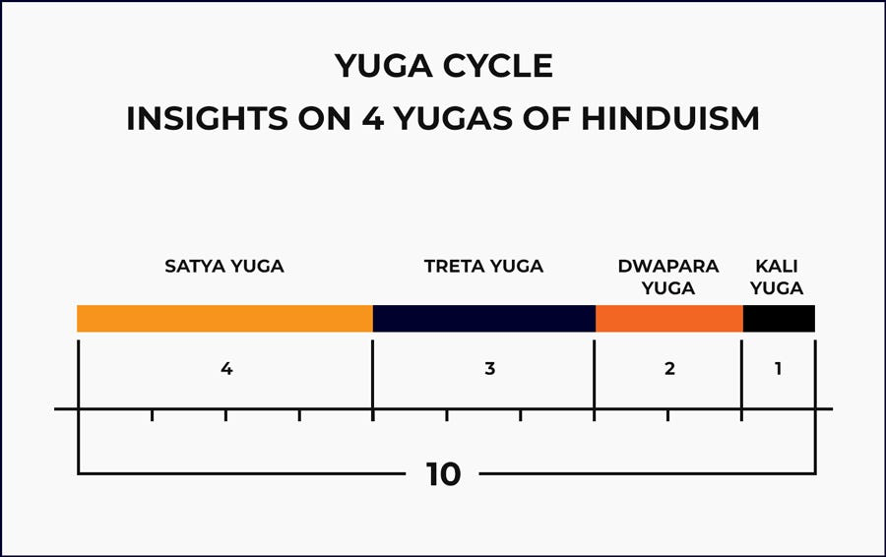
The explanation is here, in this chart, where we can see how each Yuga period was assigned a length of time. The sum of the time periods of the four Yugas equals 10. It takes 10 suberas of 179 years to match the previous arrangement with this modern arrangement, which has given us the exact duration of a precessional year of 25,776 years.
My theory on the organization of time, based on the Eras of axial precession, is supported, as I mentioned, by global events in history and in proving that they repeat. Confirming the year 2025 AD, indicated in the Yugas 5,100 years ago, is a priority, and it would indicate that yes, everything is a cycle of repetition. To do this, I will analyze historical events and, based on the eras of 2,148 years and suberas of 179 years, prove it.
