



Volcanoes
May 16, 2025Content
Basis of precessional astrology of the Ages for natural phenomena
Natural phenomena can be predicted, and therefore we can prepare for them.
This is my conclusion after applying the axial precession measurement units of eons (Platonic year) of 25,776 years, eras of 2,148 years, suberas of 179 years, and half-suberas of 89.5 years to the natural phenomena of volcanoes, earthquakes, and solar flares. All of them respond positively to the application of this technique when their cycles or half-cycles complete on the dates they should, demonstrating that the predictive method of axial precession works.
Ultimately, I applied this predictive technique to the quintessential natural phenomena, those that geologists classified as massive natural phenomena that generated the ice ages. When analyzing the last ice age, the result was identical to the analysis of volcanoes, earthquakes, and solar flares.
Years ago, I applied this same predictive technique to organize the time of the Ages using historical, social, and economic events that occurred in the past. These events also demonstrated, by naturally positioning themselves above or below the wave frequencies of Aeons, Ages, and Sub-Aeons, that there is a natural ordering to the events that affect us. There is a cyclical order in which events manifest, an order governed by axial precession and its subdivision into 12 fields of the ecliptic, and again into 12 by the curves or waves that are generated, which I call harmonic wave frequencies.
World or mundane astrology
The so-called world or mundane astrology has always dealt with this branch of traditional astrology, specializing in predicting future global events. It does so by analyzing planetary transits and the so-called small and large cycles of planetary transits that have occurred in the past, extracting information about their effects at the time they occurred on society as a whole at that time and extrapolating this information to a present or future time when that cycle will occur again, thus being able to predict its consequences.
Yugas or 4 Yuga´s period
It’s worth remembering in this section that there is another predictive method, one that is the oldest of all, called the Yugas, or the four Yuga periods into which the ancient sages of the Indus civilization divided time. Much written information survives from that period, including texts such as the Mahabharata, Krishna’s dialogues with the goddess Ganges, the Vedas, the Upanishads, and the Bhagavad Gita, all commonly used in India today. From them emerges an eternal cycle of time, a wheel from which one cannot escape, always interpreted as the circumference generated in the plane of the elliptical by the motion of the planet on its axis and with its axial inclination called axial precession.
I present all the complete information in the “Time Ordering of the Ages” so I will not expand further in this section, except to remind you that the Yugas agree that it is in the changes of Yugas and their transitions where natural phenomena occur as critical global events.
Precessional astrology or astrology of the Ages
Within astrology, there is another virtually unknown branch called precessional astrology or astrology of the Ages, which is the one I experiment with. This doesn’t use planetary transit cycles, but rather these units of measurement in years of axial precession, and applies them directly to the date on which an event of any magnitude occurred in the past. By applying one of these units of measurement in years to the date of the event, one can calculate when the cycle will repeat halfway or completely, indicating when the number obtained is exactly one or half of the cycle.
I will begin the analysis of natural phenomena from the most distant time, the ice ages, and will move forward in time by analyzing the phenomena that have occurred in the last four years. Finally, I will delve into the near future, up to 2049 AD, in order to give the necessary importance to the year 2025 AD, when the analysis concludes that the cycle of class X solar flares will repeat.
Last Ice Age
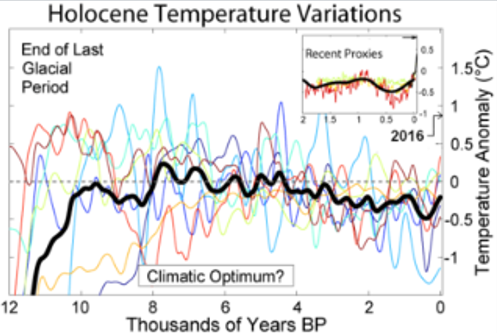
The analysis I present below covers the period of the last 26,000 years, which included the last ice age, the so-called Würm glaciation, and its subsequent Holocene period. Since this is the most recent period, it is also the easiest for geologists to analyze, as the closer the period is to the present, the more reliable and extensive the information obtained.
Cyclical pattern
In both periods, the natural phenomena of Wúrm and the radical temperature changes of the Holocene that I have been finding fit perfectly with the maximums and minimums of this 2,506-year pattern that I have discovered. The 2,506-year cyclic pattern is nothing other than a wave frequency or curve that is directly related to the axial precession of 25,776 years, as it can be measured in one of its units, the subera of 179 years, since it is divisible exactly 14 times by itself.
| Glaciation / Interglaciation | Start, in years |
|---|---|
| Holocene | 9700 B.C. |
| Würm Glaciation | 110 000 |
| Riss-Würm Interglaciation | 140 000 |
| Riss Glaciation | 200 000 |
| Mindel-Riss Interglaciation | 390 000 |
| Mindel Glaciation | 580 000 |
| Günz-Mindel Interglaciation | 600 000 |
| Günz Glaciation | 850 000 |
| Holocene Stages | Start, in years |
|---|---|
| Temperature increase | 10.000 B.C. |
| Holocene Maximum | 6.000 B.C. |
| Cooling | 2.500 a.C. |
| Medieval Warm Period | 900 A.D. |
| Little Ice Age | 1.300 A.D. |
| Global warming | 1.850 A.D. |
| COPPER AGE | BRONZE AGE | IRON AGE |
|---|---|---|
| From 5.000 B.C. to 1.800 B.C. | From 1.800 B.C. to 800 B.C. | From 800 B.C. to I Century B.C |
Yugas Aplication
The interesting thing about this analysis is not only that all the periods of the Wurm Glaciation and the Holocene fit within the maximum or minimum of these wave frequencies, but also that, when the predictive method of the Yugas is applied, the periods fit perfectly alongside these periods. The same is true of the two most powerful X-class flares ever recorded, the construction phases of our recent ages seen as Metal Ages, and the fall of empires due to climatic actions. They all have a common link: they are the result of natural phenomena on a greater or lesser scale.
Likewise, the Wurm Glaciation of 110,000 years is divisible by 2,148 years, or 1 Age, and again gives a whole number, or 0.5.
I have calculated the Age of Cancer of that period, and it was in 111804 BC. Both represent the same moment, they are the consequences of a fluctuation, of a change, and of course, it has to occur, as any astrologer knows, under the sign of Cancer, the beginning of humanity, given that the other possibility is Aries, but this sign indicates the beginning of everything, not of humanity.
111.804/2148 years = 52.0 Eras
